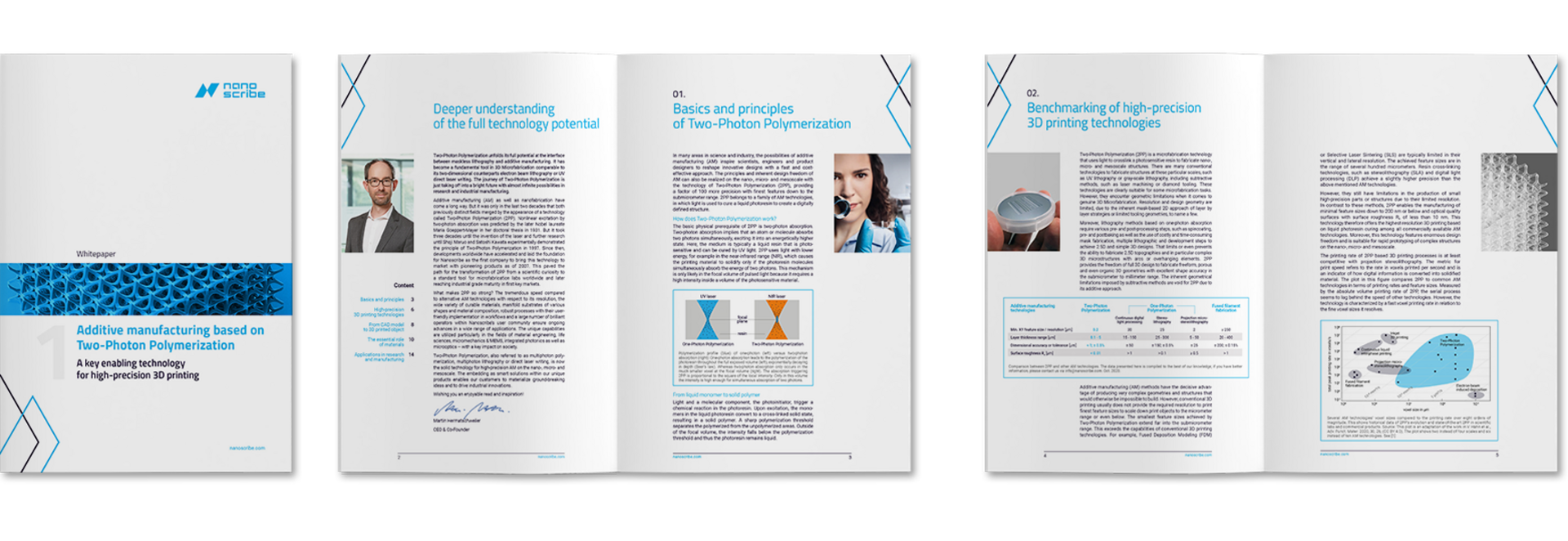
Additive manufacturing based on Two-Photon Polymerization
A key enabling technology for high-precision 3D printing
Two-Photon Polymerization unfolds its full potential at the interface between maskless lithography and additive manufacturing. It has become a fundamental tool in 3D Microfabrication comparable to its two-dimensional counterparts electron beam lithography or UV direct laser writing. The journey of Two-Photon Polymerization is just taking off into a bright future with almost infinite possibilities in research and industrial manufacturing.
Additive manufacturing (AM) as well as nanofabrication have come a long way. But it was only in the last two decades that both previously distinct fields merged by the appearance of a technology called Two-Photon Polymerization (2PP). Nonlinear excitation by two-photon absorption was predicted by the later Nobel laureate Maria Goeppert-Mayer in her doctoral thesis in 1931. But it took three decades until the invention of the laser and further research until Shoji Maruo and Satoshi Kawata experimentally demonstrated the principle of Two-Photon Polymerization in 1997. Since then, developments worldwide have accelerated and laid the foundation for Nanoscribe as the first company to bring this technology to market with pioneering products as of 2007. This paved the path for the transformation of 2PP from a scientific curiosity to a standard tool for microfabrication labs worldwide and later reaching industrial grade maturity in first key markets.
What makes 2PP so strong? The tremendous speed compared to alternative AM technologies with respect to its resolution, the wide variety of curable materials, manifold substrates of various shapes and material composition, robust processes with their user-friendly implementation in workflows and a large number of brilliant operators within Nanoscribe’s user community ensure ongoing advances in a wide range of applications. The unique capabilities are utilized particularly in the fields of material engineering, life sciences, micromechanics & MEMS, integrated photonics as well as microoptics – with a key impact on society.
Two-Photon Polymerization, also referred to as multiphoton polymerization, multiphoton lithography or direct laser writing, is now the solid technology for high-precision AM on the nano-, micro- and mesoscale. The embedding as smart solutions within our unique products enables our customers to materialize ground-breaking ideas and to drive industrial innovations
Table of Contents
01. Basics and principles of Two-Photon Polymarization
The basic physical prerequisite of 2PP is two-photon absorption. Two-photon absorption implies that an atom or molecule absorbs two photons simultaneously, exciting it into an energetically higher state. Here, the medium is typically a liquid resin that is photosensitive and can be cured by UV light. 2PP uses light with lower energy, for example in the near-infrared range (NIR), which causes the printing material to solidify only if the photoresin molecules simultaneously absorb the energy of two photons. This mechanism is only likely in the focal volume of pulsed light because it requires a high intensity inside a volume of the photosensitive material.
From liquid monomer to solid polymer
Light and a molecular component, the photoinitiator, trigger a chemical reaction in the photoresin. Upon excitation, the monomers in the liquid photoresin convert to a cross-linked solid state, resulting in a solid polymer. A sharp polymerization threshold separates the polymerized from the unpolymerized areas. Outside of the focal volume, the intensity falls below the polymerization threshold and thus the photoresin remains liquid.
Smart integration and control of powerful hardware
High-precision 2PP requires a well-tuned system involving a laser, an objective lens and typically a liquid photosensitive material. By means of an objective lens, a pulsed laser beam is focused into a very tight region inside a volume of a photosensitive material. Even though the average power of the laser might seem quite low, the laser emits ultrashort light pulses that contain a high photon density.
For fast and precise printing, galvo scanners move the focal point in the focal plane at speeds of hundreds of millimeters per second. In addition, a state-of-the-art stage system with nanopositioning capabilities in all three dimensions moves the substrate with the photoresin to build up 3D microstructures.
This technology is not only used to fabricate microparts on plane substrates but also to directly print complex structures on preexisting patterns and topographies, e.g., on photonic chips, inside sealed microfluidic channels or on optical fiber tips.
To read the full Whitepaper register or log in to premium
02. Benchmarking of high-precision 3D printing technologies
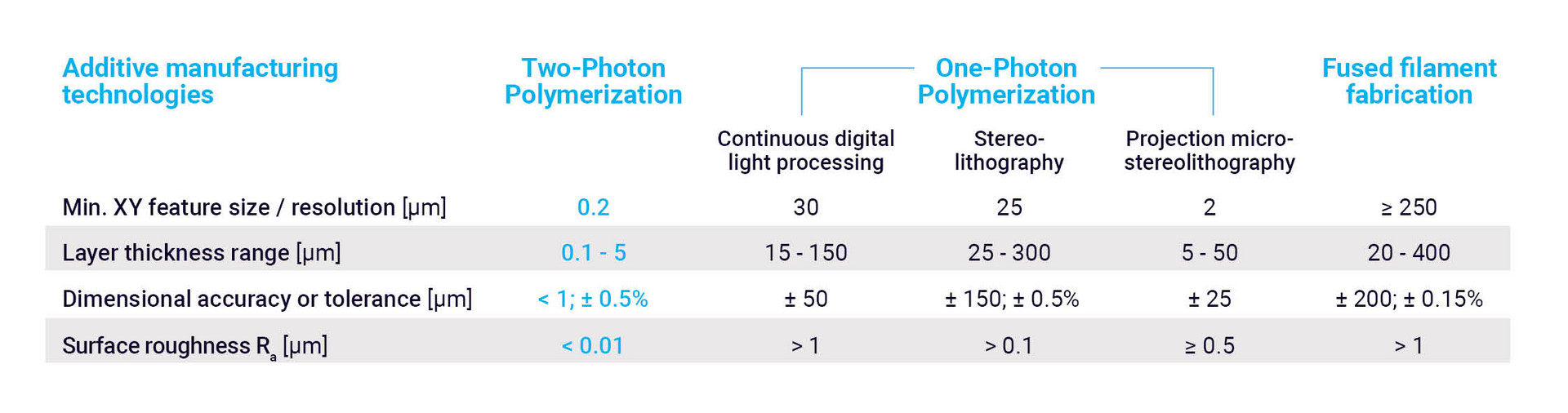
Two-Photon Polymerization (2PP) is a microfabrication technology that uses light to crosslink a photosensitive resin to fabricate nano-, micro- and mesoscale structures. There are many conventional technologies to fabricate structures at these particular scales, such as UV lithography or gray-scale lithography, including subtractive methods, such as laser machining or diamond tooling. These technologies are clearly suitable for some microfabrication tasks. However, they encounter geometric limitations when it comes to genuine 3D Microfabrication. Resolution and design geometry are limited, due to the inherent mask-based 2D approach of layer by layer strategies or limited tooling geometries, to name a few.
Moreover, lithography methods based on one-photon absorption require various pre- and post-processing steps, such as spincoating, pre- and postbaking as well as the use of costly and time-consuming mask fabrication, multiple lithographic and development steps to achieve 2.5D and simple 3D designs. That limits or even prevents the ability to fabricate 2.5D topographies and in particular complex 3D microstructures with arcs or overhanging elements. 2PP provides the freedom of full 3D design to fabricate freeform, porous and even organic 3D geometries with excellent shape accuracy in the submicrometer to millimeter range. The inherent geometric limitations associated with subtractive methods are overcome with 2PP due to the additive approach.
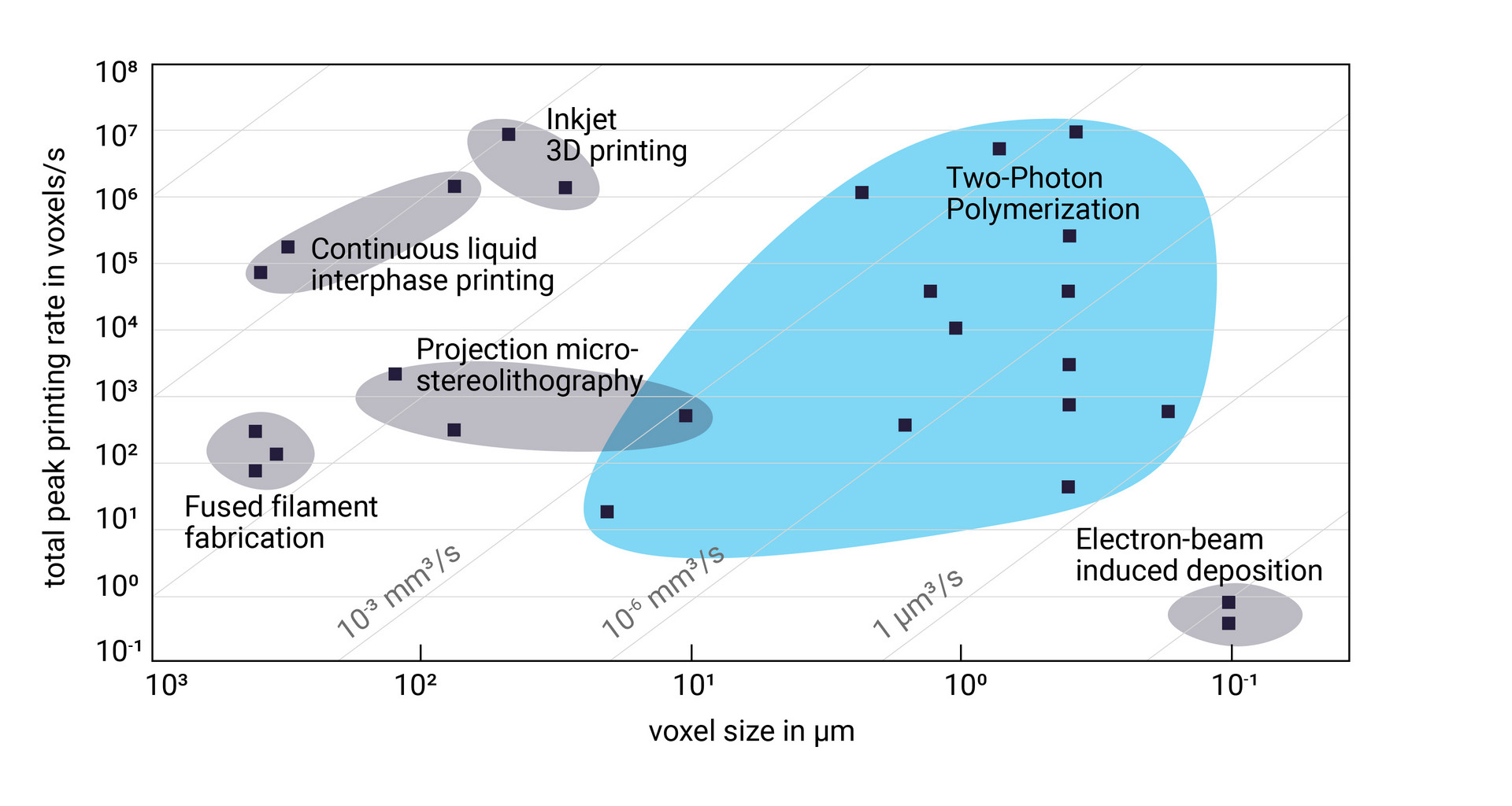
The printing rate of 2PP based 3D printing processes is at least competitive with projection stereolithography. The metric for print speed refers to the rate in voxels printed per second and is an indicator of how digital information is converted into solidified material. The plot in this figure compares 2PP to common AM technologies in terms of printing rates and feature sizes. Measured by the absolute volume printing rate of 2PP, the serial process seems to lag behind the speed of other technologies. However, the technology is characterized by a fast voxel printing rate in relation to the fine voxel sizes it resolves.
Register or log in to Premium to get the full whitepaper
03. From CAD model to 3D printed object
To read the full Whitepaper register or log in to premium
04. The essential role of materials
The choice of resins and substrates is crucial for the quality, function and functionality of the final printed structures. The decision for a specific printing material determines the intended final qualities of the printed object, such as resolution, surface roughness, specific chemical, mechanical or optical properties and, last but not least, the printing time. Appropriate substrate materials in turn ensure robust and reliable printing workflows.
Substrates as the basis for 3D printing
For 3D printing of delicate high-precision components, suitable substrates are particularly important for an appropriate printing process. To ensure professional handling throughout the printing process, the small objects and filigree structures are printed on a substrate as supporting base. The substrates are chosen according to the preferred printing configuration and the desired resin-objective combination.
During the printing process, the printed structure and the substrate are precisely aligned and firmly attached. Printing is applied on quartz glass, borosilicate glass and silicon wafers, for example, which are the most commonly used substrates. Moreover, more and more scientific and industrial innovators demonstrate how Nanoscribe's 3D Microfabrication technology can be used to successfully print directly onto functional components, such as
- single mode fibers
- photonic chips
- semiconductor (CMOS) image sensors
- microfluidic chips
- MEMS actuators
Printing Polymers
Thermoset polymers are the dominant material class for Two-Photon Polymerization (2PP). The polymer chains in a thermoset are strongly cross-linked and thus form an infusible and insoluble network. The most common chemical mechanism for thermoset curing in 2PP-based 3D printing is light-stimulated radical polymerization.
The induced chemical reaction in brief: In the laser focus two photons are absorbed at once, each with near-infrared energy to effectively excite a polymerization reaction that requires energy equivalent to UV light. As a result of this reaction a solid, insoluble thermoset polymer is formed within the exposed resin volume.
Post-processing options for 3D-printed structures
Besides the development of the printed structure, which simply means removing the unpolymerized material, there are some post-processing procedures. Two common methods are thermal or UV post-treatments to ensure optical and mechanical material properties as well as the preparation of the printed object for SEM analysis by sputter coating the structure with a thin conductive layer.
With post-print processes, such as 3D casting, 2.5D replication, atomic layer deposition (ALD), chemical vapor deposition (CVD) or pyrolysis, 3D-printed structures are modified and transferred to other materials as plastics, ceramics, dielectrics, metals or carbon:
- 2.5D Replication: 2PP printed 2.5D polymer masters perfectly support standard mass replication processes, such as injection molding, (direct) hot embossing and nanoimprint lithography, which even opens the way to step and repeat processes for wafer-scale manufacturing.
- 3D Casting: The casting of 3D-printed structures creates a mold for micro injection molding. This post-processing step is essential for single-unit replication of positive or negative molds based on a lost cast.
- Atomic layer deposition: Printed foams are coated with ALD and the selective etching of small perforations allows to remove the polymer to create ceramic foams.
- Chemical vapor deposition: Materials can be deposited uniformly by CVD in order to provide access to further materials, such as silicon; this often is performed in combination with ALD.
- Pyrolysis: The combination of 2PP and subsequent pyrolysis in a vacuum at 900 °C is used to fabricate nanostructured carbon materials that are lightweight and ultra-strong.
Register or log in to Premium to get the full whitepaper
05. Wide range of pplications in research and manufacturing
Two-Photon Polymerization (2PP) provides high precision in 3D printing and enormous design freedom as well as straightforward printing for a wide range of applications. Scientists and engineers in R&D organizations and industry are using this technology for pioneering work in many sectors, such as materials science, photonic packaging, microoptics, microfluidics and tissue engineering, high-lighted in more than 2,500 peer-reviewed journal publications. 3D Microfabrication enables both rapid innovation cycles to accelerate the direct prototyping of novel designs and the fabrication of polymer masters for upscaling production.
The spectrum of applications is constantly growing due to the simplified workflow and the wide range of possible printing materials and substrates. An emerging trend is the fabrication of objects and structures directly onto functional components such as optical chips, microfluidic channels or fibers.
Microstructures with complex functional designs
A major challenge in regenerative medicine is the vascularization of engineered tissues to create dense networks of microscale vessels that can perfuse even large volumes of tissues. A new microfluidic strategy, enabled by Two-Photon Polymerization-based 3D printing, allows the fabrication of networks of synthetic 3D microvessels, consisting of tubular 3D hydrogel structures. These complex microfluidic systems can perfuse tissues many cubic millimeters in size. This allows the tissues to survive for long periods of time and show cell proliferation and differentiation in the in vitro cultures.
3D-printed microvessels for tissue vascularization
The clue to the required diffusion characteristics of the vascular network lies in the choice of material. The scientists developed a custom material based on a soft, non-swelling hydrogel that allows the exchange of oxygen, nutrients and waste. The non-swelling properties of the hydrogel are essential to avoid breaking the seal between the soft microfluidic lattice and the plastic base on which the grid was 3D printed.
The novel 3D soft microfluidic cell culture platform provides microperfusion for various tissue constructs. Starting from stem cells, the scientists created cerebral organoids and liver tissue constructs using controlled differentiation, a process through which stem cells acquire their specific roles in the body (e.g., become neurons or hepatocytes). They discovered that microperfusion significantly enhanced tissue growth and accelerated differentiation process compared to non-perfused tissues and conventional cell culturing. Furthermore, the analysis of the perfused neural tissue confirmed the high viability of the tissues over long periods of time.
Master replication and in-chip printing for microfluidic devices
Microfluidics encompasses the science and technology of systems that precisely control and manipulate liquids in very small volumes, e.g. in lab-on-a-chip devices for chemical, biological or physical studies. To exploit the behavior of microfluidics for technological use, microdevices must integrate several elements in small space, such as microfluidic channels, active and passive components like filters, valves or mixers. Advances in 2PP allow to create not only 2D and 2.5D structures for the fabrication of microfluidic channels from printed polymer masters but also to print nearly any 3D object inside an open or even sealed microchannel.
Freeform micronozzle inside microfluidic channels
Mastering and in-chip 3D printing are combined to miniaturize a wetspinning process in a microfluidic chip: First, a positive master of the microfluidic channel system is printed, using a 25x 0.8-NA objective lens and the IP-S photoresin. Then, by casting PDMS over the printed channels, a negative mold is fabricated that possesses the channel structures. This PDMS slab is sealed by adhering it to a microscope slide using oxygen plasma. The channels are then filled with IP-L photoresin, followed by an in-chip 3D printing step.
Using a 63x 1.4-NA objective lens to focus the laser beam inside the channel, a 3D nozzle with an inner diameter of only 12 µm is printed. The unpolymerized material is then washed away by rinsing the channels with solvents. By miniaturizing a spider-inspired spinneret nozzle embedded in the microfluidic channels, a wet-spinning process is established which enables wet-spun monofilaments with dimensions of native spider silk.
Printing biopolymer scaffolds for the regeneration of retinal cells
One example that demonstrates the exceptional material diversity available for 2PP is the development of 3D scaffolds from naturally occurring materials to mimic the biochemical and biomechanical properties of natural tissues. In this work, scientists investigate four different biopolymer formulations for 3D printing extracellular matrices: methacrylate-modified collagen, gelatin, hyaluronic acid (HA) and polycaprolactone (PCL). All materials confirm biocompatibility by cultivating different cell types on the printed microstructures for several days and by testing according to ISO 10993. Furthermore, the PCL scaffolds, which carry photoreceptor cells, were transplanted into the sub-retinal space of pigs for more than 30 days. During this period, there was no evidence of retinal injury, inflammation, systemic toxicity or tumor formation. According to the researchers, the ability of fabricating such porous 3D scaffolds and the versatility offered by 2PP make this technology the best way to restore, e.g. neural function in patients with neurodegenerative diseases
To read the full Whitepaper register or log in to premium
Get the full whitepaper
Download this 20-page whitepaper, after a free registration, and obtain a profound overview of 3D Microfabrication based on Two-Photon Polymerization.