


3D-printed micro-optics on photonic devices
Micro-optical components are becoming essential wherever light must be shaped, collected, or coupled with minimal loss and minimal footprint. Quantum X align fabricates freeform micro-optics directly on photonic devices, eliminating assembly complexity while enhancing optical efficiency, device functionality, and integration density.
Micro-optics printed directly on photonic devices
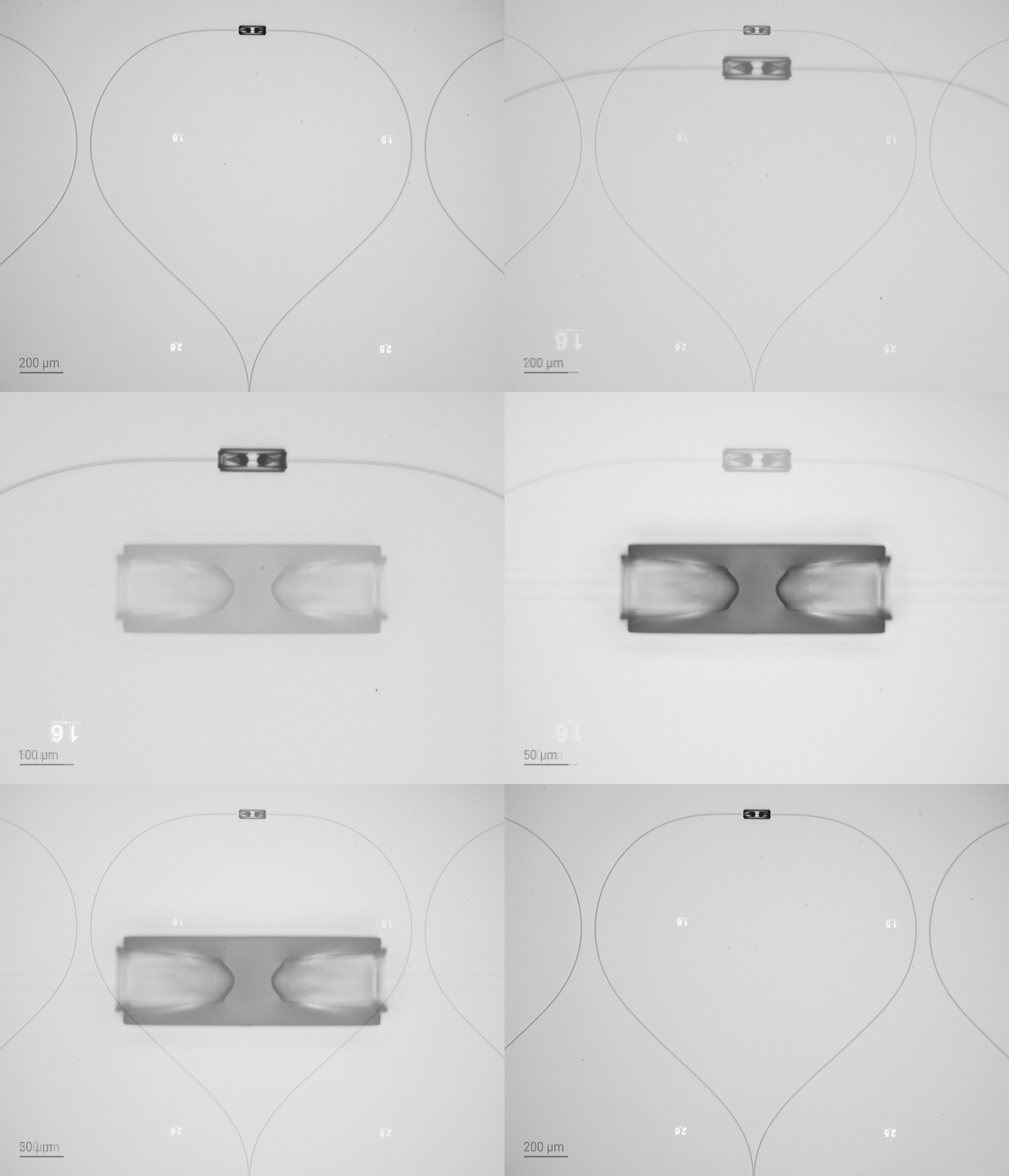
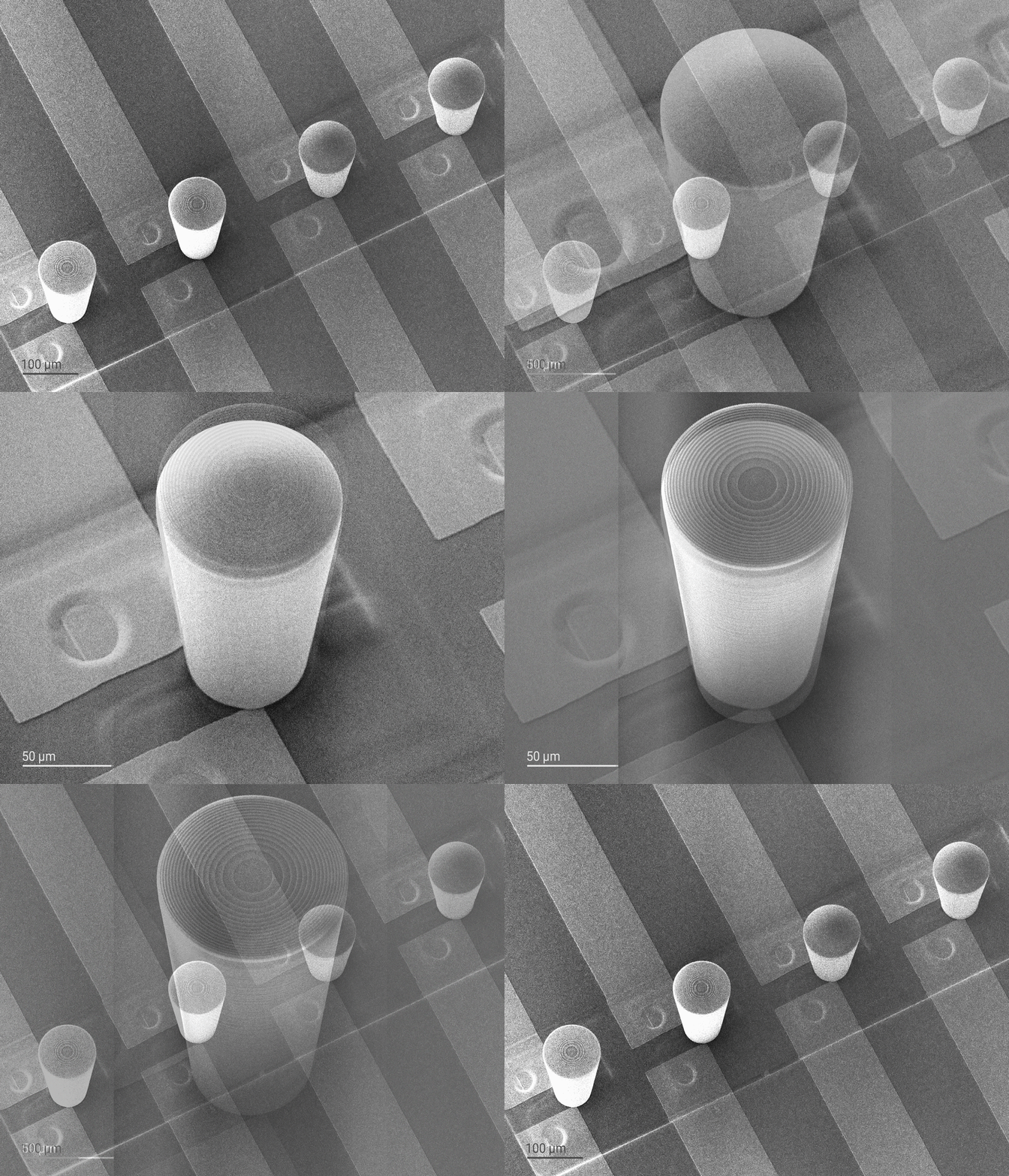
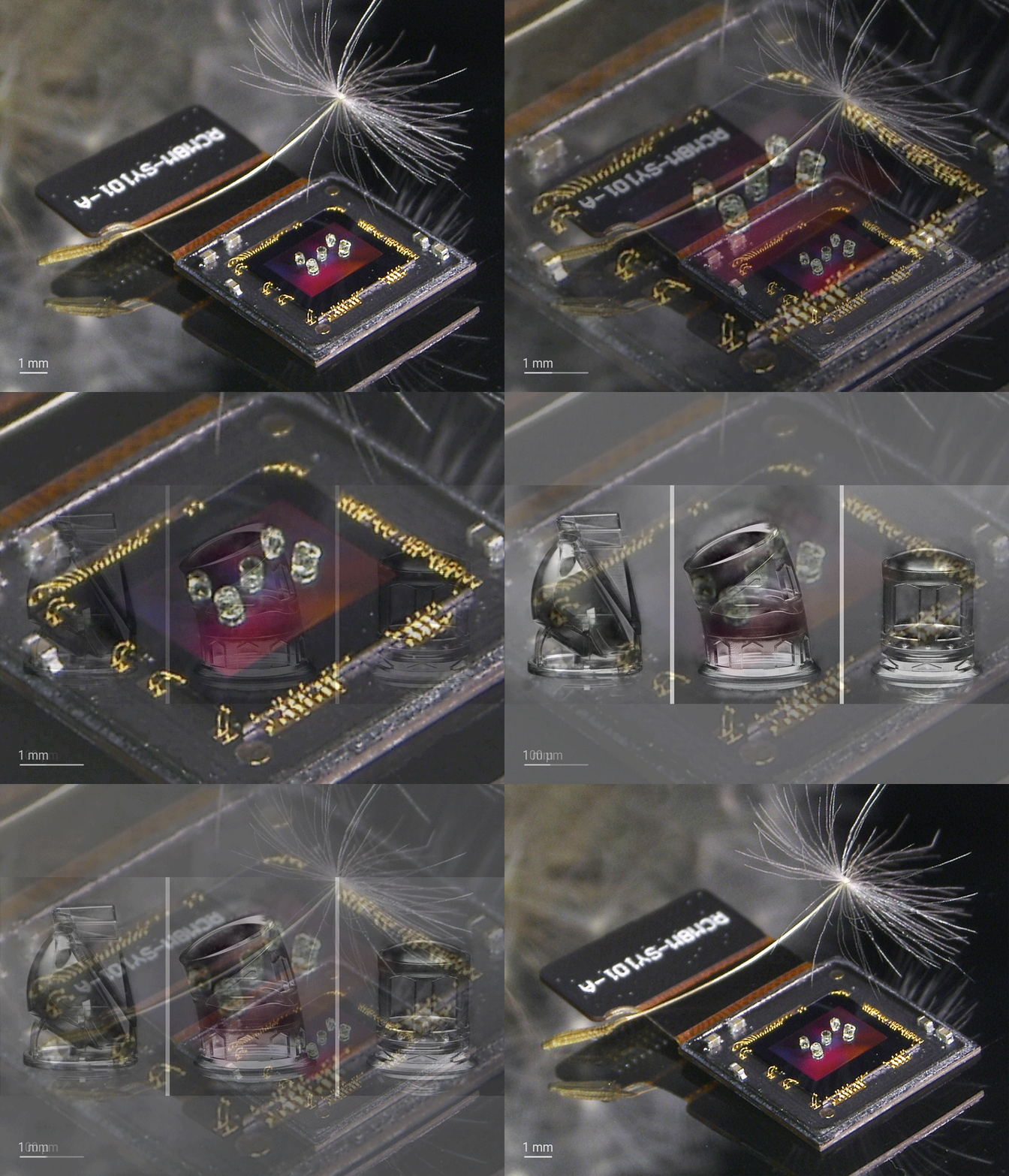
Freeform optics directly integrated on photonic devices
As photonic systems shrink, performance is increasingly limited by inefficient light collection, and strict alignment requirements. Printing micro-optics directly onto photonic devices such as emitters, photodetectors, and CMOS image sensors addresses these challenges by reducing footprint and assembly complexity while improving coupling efficiency and enhancing optical functionality.
In-situ printed micro-optics on photonic devices
Micro-optics printed directly on photonic devices add optical functionality exactly where light is generated, guided, detected, or modulated. Instead of assembling separate optical components after device fabrication, freeform micro-optics can be printed directly onto photonic chips, emitters, photodetectors, CMOS image sensors, and other functional surfaces. This enables compact optical functions for beam shaping, light collection, focusing, filtering, steering, coupling, or mode adaptation directly at the point where optical performance is needed.
The key requirement across these use cases is precise positioning and integration on device topographies, including structured, recessed, pre-processed, heterogeneous, or already packaged surfaces. Quantum X align addresses this challenge by combining design freedom with automated alignment down to 100 nm detection accuracy and high-resolution 3D microfabrication. As a result, micro-optics can be fabricated directly on the device, reducing assembly effort, minimizing optical interfaces, and enabling application-specific performance improvements in compact photonic systems.
Why Quantum X align for micro-optics on photonic devices
Quantum X align combines automated device alignment, with patented Two-Photon Grayscale Lithography (2GL®) in one powerful platform. It enables the fast and precise fabrication of high-performance freeform micro-optics directly on photonic devices.
-
Automatic alignment for reduced assembly effort: Print micro-optics directly onto photonic devices such as emitters, detectors, CMOS image sensors, and other functional components. Integrate the optical function on the device instead of assembling and aligning multiple optical components, reducing both assembly effort and system footprint.
-
Printing on complex device topographies: Fabricate micro-optics directly on structured 3D topographies, heterogeneous assemblies, and packaged devices, including chip edges and trenches, across a wide range of substrate materials.
-
Optical design freedom: Realize refractive, diffractive, freeform and hybrid optical elements tailored for beam shaping, coupling, focusing, and light collection.
-
Optical-grade quality: Achieve excellent shape accuracy and optical-grade surface quality with roughness values down to Ra ≤ 5 nm, enabling low scattering and high optical performance using 2GL®.
-
Validated materials: Access proprietary, validated resins with high transparency from UV to NIR wavelengths, different refractive indices and Abbe numbers, and proven environmental stability. Materials have been tested under conditions including temperature shock, damp heat, standard and high-temperature solder reflow, and mechanical shock.
Your questions answered: 3D printing of micro-optics on photonic devices
Why print micro-optics directly on photonic devices instead of assembling them afterwards?
Many photonic devices lose performance not because the device itself is inefficient, but because coupling, collection, focusing, or beam shaping happens too far away from the functional surface. Conventional assembly introduces positioning tolerances, packaging effort, and additional interfaces that can increase losses or crosstalk. Direct printing helps overcome these bottlenecks by placing the optical element exactly on the emitter, detector, sensor, or waveguide, where even sub-micrometer misalignment can significantly affect performance. Quantum X align is specifically designed for this challenge, enabling optical elements to be aligned and fabricated directly on photonic devices in a single workflow rather than relying on subsequent assembly and positioning steps.
What optical elements can be fabricated with high-resolution 3D printing?
Freeform, refractive, diffractive, and hybrid optical elements can be fabricated directly on planar, pre-processed surfaces or chip edges without requiring dedicated tooling. This enables rapid prototyping, application-specific customization, and the realization of optical geometries that are difficult or impossible to manufacture and integrate using conventional optics fabrication and assembly methods. The digital manufacturing workflow and automated alignment provides a scalable path from development to industrial production.
What applications benefit most from in-situ printed micro-optics?
This approach is especially valuable wherever compact integration and precise optical control are required. Typical examples include detector enhancement, compact imaging optics on CMOS image sensors, optical couplers, and light collection or beam-shaping elements on emitters and detectors. It is particularly attractive for systems where space is limited, optical alignment is challenging, and device performance depends strongly on efficient light delivery or collection.
What are the 3D-printed micro-optics made of?
Using Two-Photon Polymerization, micro-optics are 3D-printed from polymer photoresins. These materials have demonstrated reliability through a range of industry-relevant environmental tests, including temperature cycling, damp heat exposure, solder reflow, and mechanical shock.
Get your project started with our products

Quantum X align
Aligned 3D printing for integrated photonics & optics

Optics manufacturing materials
Resins optimized for fabrication of microoptical elements

Turnkey process-line solution
Your guided path to industrial-scale microfabrication
Explore 3D-printed micro-optics on photonic devices
Get inspired by these scientific highlight publications, showcasing micro-optics on photonic devices created with Nanoscribe’s high-resolution 3D printing technology. For even more insights, explore over 2,500 peer-reviewed scientific publications in our premium resources section – simply log in or register for free.
On-chip optical tweezers based on freeform optics

Authors: S. Yu,J. Lu, V. Ginis, S. Kheifets, S.W. D. Lim,M. Qiu,T. Gu, J. Hu, F. Capasso
Affiliation: Massachusetts Institute of Technology, Harvard University, Westlake University, Vrije Universiteit Brussel, College of Optical Science and Engineering
Journal: Optica 8, 409-414 (2021)
Ultra-compact 3D-printed wide-angle cameras realized by multi-aperture...
Authors: A. Toulouse, J. Drozella, P. Motzfeld, N. Fahrbach, V. Aslani, S. Thiele, H. Giessen, A. M. Herkommer
Affiliation: University of Stuttgart
Journal: Optics Express 30, 707-720 (2022)
Low-Divergence hBN Single-Photon Source with a 3D-Printed...
Authors: J. A. Preuß, H. Gehring, R. Schmidt, L. Jin, D. Wendland, J. Kern, W. H. P. Pernice, S. Michaelis de Vasconcellos, R. Bratschitsch
Affiliation: University of Münster
Journal: Nano Letters; 23 (2): 407–413 (2023)
Resolving Power of Visible to Near-Infrared Hybrid β-Ta NbTiN
Authors: K. Kouwenhoven, D. Fan, E. Biancalani, S. A.H. de Rooij, T. Karim, C. S. Smith, V. Murugesan, D. J. Thoen, J. J.A. Baselmans, P. J. de Visser
Affiliation: Netherlands Institute for Space Research (SRON), Delft University of Technology, Leiden Observatory
Journal: Physical Review Applied 19, 034007 (2023)