


IP-Visio
IP-Visio is a high-performance photoresin that is non-cytotoxic and exhibits low autofluorescence. It is ideal for 3D printing applications in cell culturing, tissue engineering, and cell microscopy.
Go beyond planar cell biology
with 3D-printed microstructures

With IP-Visio, intricate structures can be fabricated with ease. Its material properties are suitable for studying cell behavior on filigree 3D-printed microstructures. The features of IP-Visio at a glance:
- Non-cytotoxic according to ISO 10993-5 / USP 87
- Very low autofluorescence for microscopy applications
- Protein-adsorbent resin for cell attachment
- Suitable for cell biology, tissue engineering and biomedical devices
Biocompatible 3D scaffolds with
IP-Visio
IP-Visio is Nanoscribe’s printing material for the fabrication of biocompatible 3D microstructures. The material is non-cytotoxic according to ISO 10993-5/ USP 87, making it suitable for cell-compatible structures.
With high shape accuracy, cell scaffolds can be printed to mimic realistic microenvironments for cell studies. Multiple cells can be seeded onto the printed scaffolds to study cellular processes and inner cell proteins in 3D.

Explore IP-Visio's potential
in cell microscopy


The parts printed with IP-Visio show very low autofluorescence. Therefore, cell behavior can be studied by fluorescence microscopy without disturbing interference of the background fluorescent structure.
Compared to our established IP-S photoresin, the autofluorescence of the printed IP-Visio structure is nearly neglectable and allows a clear view of cells and subcellular components.
IP-Visio features and use
-
Refractive index at 589 nm, 20 °C1: 1.511
-
Fluorescence: low
-
Biocompatibility: Yes2
-
Compatible Print Set: Medium Features
1 Measured on 3D printed or UV-cured structures; results depend on the printing conditions and geometry
2 Non-cytotoxic according to ISO 10993-5
High-res 3D biofabrication
-
Life sciences
-
Cell growth
-
cell migration
-
stem cell differentiation
-
tissue engineering
-
organ-on-a-chip
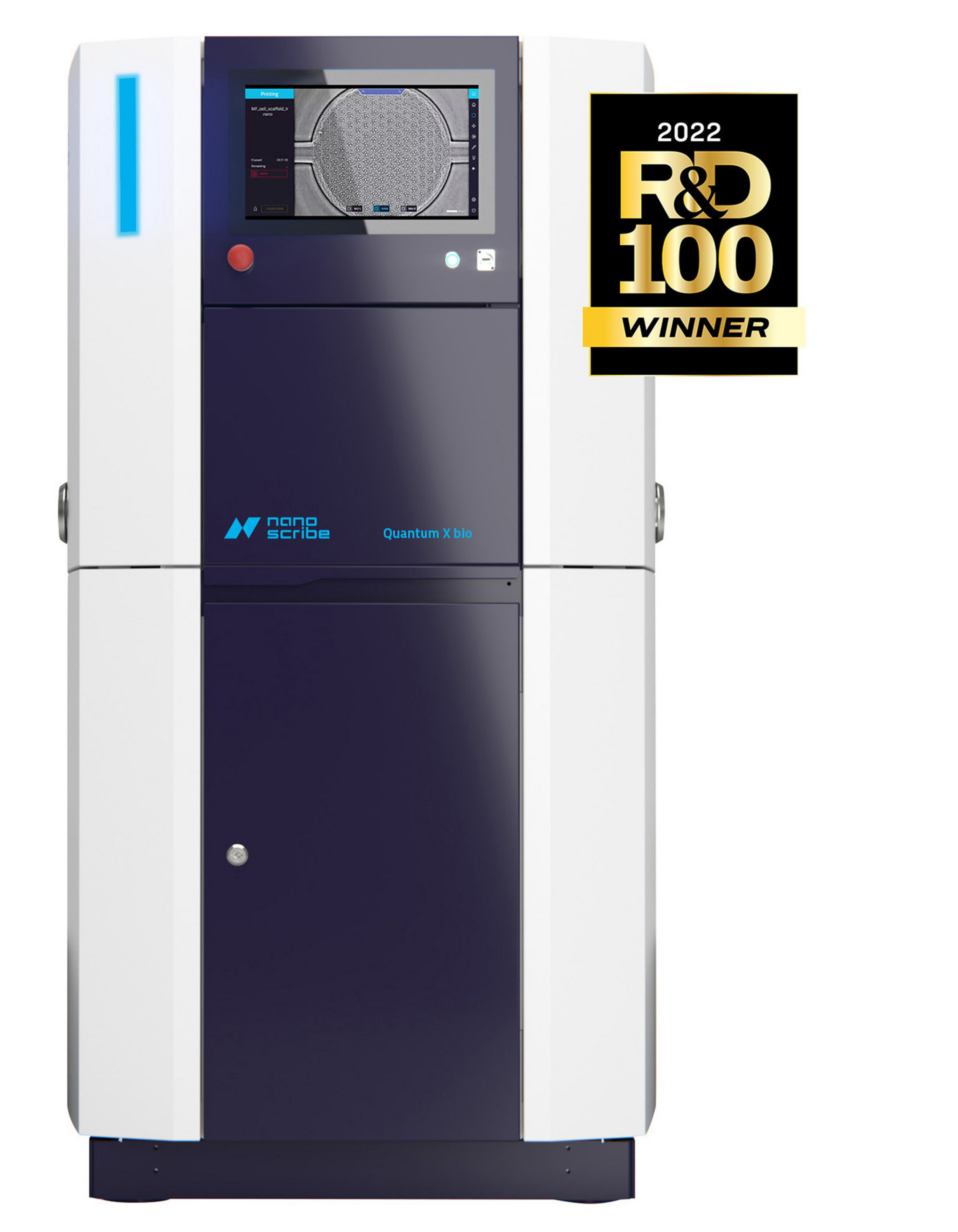
Quantum X bio
High-resolution
3D bioprinter
Interested in further
high-precision printing materials?
Nanoscribe’s photoresins are proven printing materials for high-precision 3D microfabrication based on Two-Photon Polymerization (2PP) and Two-Photon Grayscale Lithography (2GL®). The IP and IPX product lines presents a wide range of photoresins designed for nano-, micro-, and mesoscale structures. In addition, a variety of bioresins and nanocomposite material for glass printing are available.